
Purpose: In this world it is often cited that less is more, therefore microscopic amounts must be the greatest. In this experiment, Scientific AmeriKen continues its pursuit of identifying just how little exercise one needs to still have benefits. In the last issue (Minimal exercise I) Scientific AmeriKen examined a 5-minute exercise strategy for strength and muscle mass. Here, we now examine a 3-minute exercise program to reduce the amount of time it takes to complete a 5 kilometer race - thus trading seconds for minutes!
Hypothesis: Scientific AmeriKen has previously demonstrated the potential of Fartlekking for improving 5K race times - which was a 20-30 minute exercise routine. Here, it is more or less a mini - fartlek - thus Scientific AmeriKen hypothesizes that it will work.
Materials and Methods: Needed for this experiment was a stop watch and a pair of running shoes. Initially, a distance of 3.1 miles (5 kilometers) through the neighborhood was mapped out and then ran to establish a baseline. Then every 1-3 days depending on how ScientificAMeriKen (at age 47) was feeling, a run around the neighborhood block was run (approximately 0.52 miles)with the goal of trying to beat the previous time. In theory, the better one does, the shorter time this exercise takes. There was no warm-up or stretch before each run, although initial pace for each half-mile run started at a slower pace. 5 kilometer race time was then reassessed approximately every 4 weeks.Results: The experiment lasted roughly 2 months (Figure 1, below). Initial 5K race time was 26:36 (mm:ss) and initial half-mile time was 3:19 (mm:ss). The final half mile time was 2:56, with the best time achieved during the experiment being 2:49. The final 5K race time was 24:06, a difference of 2:30 seconds.
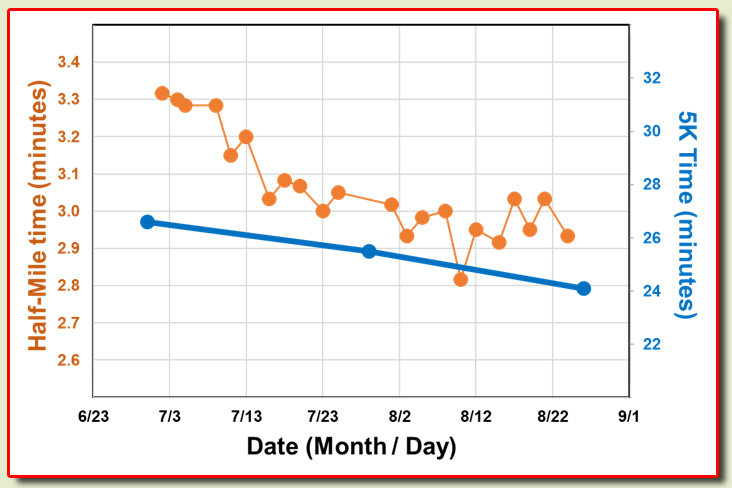
Figure 1. Changes in time to complete half-mile and 5K distances. Dots represent attempted exercise sessions, which occured between the months of June and August.
Discussion/Conclusion: Minimal exercise again accomplishes improvements with just a few minutes of time invested per day. This time, improving 5K time to 24 minutes! It is noted that in the previous fartlek experiment in a 35ish year old ScientificAmeriKen started at ~25 minutes and improved to 21 minutes. It is noted though that running the 5K race can also have beneficial benefits, it is possible that it is the 5K race effort that lead to improved subsequent 5K times, and perhaps the half-mile runs do not improve but just maintain these gains. Then again, it was observe that half-mile race times were getting better - so this does support that it was the minimal exercise that contributed. Scientific AmeriKen also notes that even though the exercise was only about 3 minutes - it was a tough 3 minutes! Therefore, future research will look to accomplish just a few seconds for minutes!
